Search results: 1806

- Teacher: Abhishek Sharma [CS]
- Teacher: Dr. Aatif Jamshed [CS]
- Teacher: MR. ABHISHEK GOYAL [CS]
- Teacher: MR. AKASH GOEL [CS]
- Teacher: Mr. Harsh Modi [CSE]
- Teacher: Dr. Saurabh Sharma [IT]
- Teacher: Mr Gaurav Parashar [CSE]
- Teacher: Mr. Mohit Tanwar [CSE]
CO1 | Demonstrate frontend web application using React JS. | P | 3 |
CO2 | Illustrate navigation and hooks in front end web application using React Router and React Hooks Library | P | 3 |
CO3 | Apply React AXIOS Library to fetch RESTful API. | P | 3 |
CO4 | Analyse backend web apps using Node JS. | P | 4 |
CO5 | Test RESTful API using Node JS. | P | 5 |
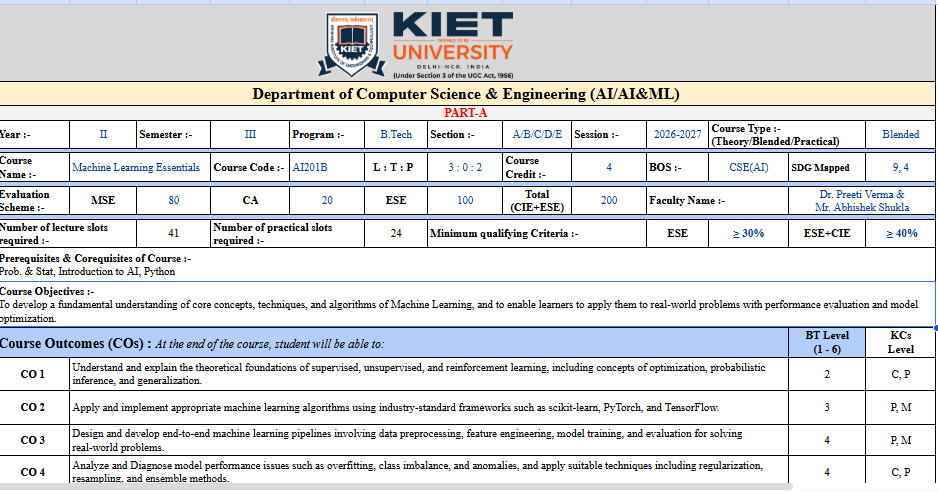
Machine Learning Essentials (AI201B)
Machine Learning Essentials is a blended course designed to develop a strong foundation in the fundamental concepts, techniques, and algorithms of Machine Learning and their application to real-world problems.
The course covers supervised, unsupervised, and reinforcement learning approaches along with regression, classification, decision trees, ensemble learning, support vector machines, k-NN, clustering, dimensionality reduction, anomaly detection, neural networks, CNNs, RNNs, LSTM, attention mechanisms, Transformers, reinforcement learning, fairness, explainable AI, differential privacy, and MLOps.
Students will gain hands-on experience in implementing Machine Learning algorithms using Python, NumPy, Pandas, Scikit-learn, PyTorch, and TensorFlow. Practical sessions and case studies will focus on data preprocessing, feature engineering, model training, evaluation, optimization, and deployment.
The course also emphasizes model performance analysis, overfitting, class imbalance, ensemble methods, fairness, interpretability, and responsible AI. Students will work on real-world applications such as housing price prediction, churn classification, fraud detection, hospital readmission prediction, sentiment analysis, customer segmentation, and anomaly detection.
Course Objectives:
Understand the fundamental concepts and principles of Machine Learning.
Learn and implement important Machine Learning algorithms.
Develop end-to-end Machine Learning pipelines.
Analyze and improve model performance using appropriate techniques.
Understand fairness, interpretability, and responsible AI practices.
Prerequisites: Probability and Statistics, Introduction to Artificial Intelligence, and Python.
Learning Approach: Lectures, interactive discussions, problem-based learning, faculty-led hands-on activities, laboratory exercises, case studies, simulation/modeling, and project-based learning.
Expected Learning Outcomes: By the end of the course, students will be able to understand ML foundations, implement ML algorithms, develop complete ML pipelines, diagnose model performance issues, and evaluate fairness and interpretability of ML models.