Dear Students,
This is to inform you regarding the Final Presentation & Viva for Project Internship (IT304P). Please carefully follow the instructions given below.
1. Scheduled Dates
- Date: 10th, October 2026
- Time: 10:00 AM - 1:00 PM
- Mode: Online – Google Meet
Students are required to be available as per their allotted presentation schedule.
2. Evaluation Parameters & Rubrics
The overall Project Internship evaluation is of 50 marks:
| Assessment Component | Marks |
|---|---|
| Presentation & Viva | 20 |
| Internship Report | 20 |
| Internship/Training Completion Certificate | 10 |
| Total | 50 |
Presentation & Viva – 20 Marks
| Parameter | Marks |
|---|---|
| Technical Knowledge | 5 |
| Problem Solving Skill | 5 |
| Use of Modern Tools | 5 |
| Communication & Ethics | 5 |
Report – 20 Marks
| Parameter | Marks |
|---|---|
| Content Organization | 10 |
| Technical Content & Understanding | 10 |
Certificate – 10 Marks
Certificate marks will be awarded as per the shared certificate evaluation rubric.
PPT Format – 10 Minutes | Maximum 8 Slides
Students are required to prepare their presentation for a maximum duration of 10 minutes.
- Title Slide – Student details, organization and internship duration
- Organization & Internship Overview – Organization, domain/role, duration and mode
- Objectives of Internship – Major objectives
- Work / Activities Undertaken – Major tasks, activities and responsibilities
- Technologies / Tools Used & Technical Work – Tools/technologies and individual contribution or technical learning
- Challenges & Problem Solving – Major challenges and solutions/approach
- Learning, Outcomes & Skill Development – Technical and professional learning and key outcomes
- Conclusion & Q&A – Key takeaways and overall internship experience
Students will be evaluated on their actual internship/training experience, technical understanding, individual contribution, communication and ability to answer viva questions.
3. Report Format
Students must prepare the Internship Report strictly as per the attached prescribed format.
The report should be based on the actual internship/training completed by the student.
4. Submission Guidelines – Moodle
Students must upload the following on Moodle:
- Internship PPT
- Internship Report
- Internship/Training Completion Certificate
Important:
- Geotagged photographs must be included in the Internship Report.
- The Internship/Training Completion Certificate should be valid and properly issued by the concerned organization.
- Please ensure that all documents are complete and properly readable before submission.
5. Feedback Form
Students are required to fill the Project Internship Feedback Form after completion of the internship evaluation.
Please ensure that all required submissions are completed before the final presentation and go through the attached rubrics and report format carefully.
All the Best!
Regards,
Internship Coordinator
3rd Year
- Teacher: KUMUD ALOK [CSE(AI)]
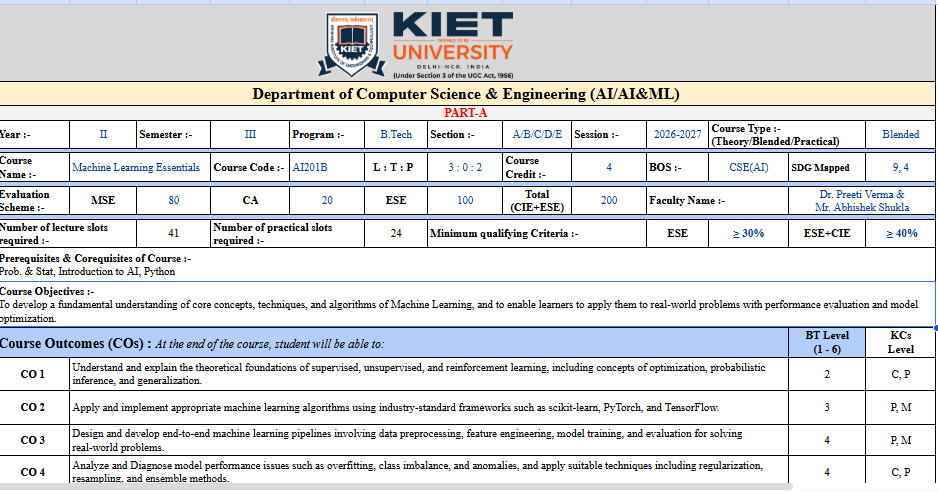
Machine Learning Essentials (AI201B)
Machine Learning Essentials is a blended course designed to develop a strong foundation in the fundamental concepts, techniques, and algorithms of Machine Learning and their application to real-world problems.
The course covers supervised, unsupervised, and reinforcement learning approaches along with regression, classification, decision trees, ensemble learning, support vector machines, k-NN, clustering, dimensionality reduction, anomaly detection, neural networks, CNNs, RNNs, LSTM, attention mechanisms, Transformers, reinforcement learning, fairness, explainable AI, differential privacy, and MLOps.
Students will gain hands-on experience in implementing Machine Learning algorithms using Python, NumPy, Pandas, Scikit-learn, PyTorch, and TensorFlow. Practical sessions and case studies will focus on data preprocessing, feature engineering, model training, evaluation, optimization, and deployment.
The course also emphasizes model performance analysis, overfitting, class imbalance, ensemble methods, fairness, interpretability, and responsible AI. Students will work on real-world applications such as housing price prediction, churn classification, fraud detection, hospital readmission prediction, sentiment analysis, customer segmentation, and anomaly detection.
Course Objectives:
Understand the fundamental concepts and principles of Machine Learning.
Learn and implement important Machine Learning algorithms.
Develop end-to-end Machine Learning pipelines.
Analyze and improve model performance using appropriate techniques.
Understand fairness, interpretability, and responsible AI practices.
Prerequisites: Probability and Statistics, Introduction to Artificial Intelligence, and Python.
Learning Approach: Lectures, interactive discussions, problem-based learning, faculty-led hands-on activities, laboratory exercises, case studies, simulation/modeling, and project-based learning.
Expected Learning Outcomes: By the end of the course, students will be able to understand ML foundations, implement ML algorithms, develop complete ML pipelines, diagnose model performance issues, and evaluate fairness and interpretability of ML models.
- Teacher: AMBARISH.GVS [CSE(AI)]
- Teacher: ANISH THAKUR [CSE(AI)]
- Teacher: Bikki Kumar [CSE(AI)]
- Teacher: Preeti Verma [CSE(AI)]
- Teacher: Ms. Deepinder Kaur [CSE(AI&ML)]