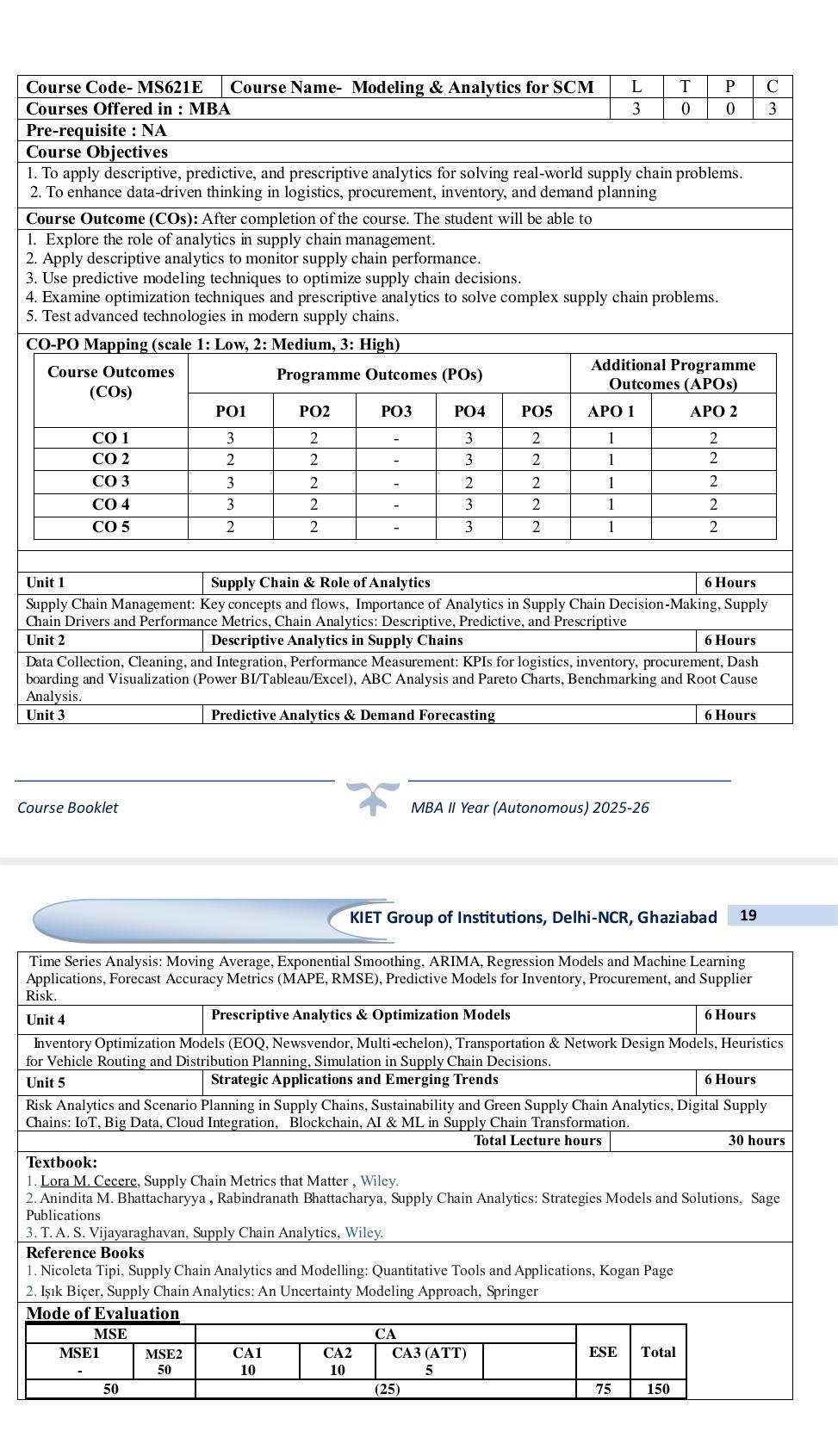
This course focuses on learning through real-life experiences, simulations, case studies, and industry interactions. It helps MBA students apply management concepts to practical business situations and develop decision-making, leadership, and problem-solving skills.
The course also explores modern trends, tools, and challenges in Operations Management, including process design, capacity planning, quality management, supply chain integration, automation, and continuous improvement in a dynamic business environment.
This course on Smart Manufacturing Systems (MS624E) focuses on World Class Manufacturing, modern product and process design, automation, digital manufacturing, TPM, and sustainable manufacturing practices. It equips MBA students with knowledge to improve operational excellence, productivity, equipment effectiveness (OEE), and sustainability in global manufacturing environments.
Syllabus outline for the MBA course Data Mining Techniques – Predictive Modeling & Pattern Discovery using R (MS617E) offered at KIET Group of Institutions, Delhi-NCR.
It covers data mining technologies, data warehousing & preprocessing, predictive modeling, R programming, and data analytics in R over 30 lecture hours. The course aims to build skills in applying data mining techniques, predictive models, and R programming for business problem-solving.
Key outcomes include applying data warehousing, preprocessing, predictive modeling, and evaluating data analytics in real-world contexts. Evaluation is based on MSE, CA (class assessments), and ESE, totaling 150 marks.
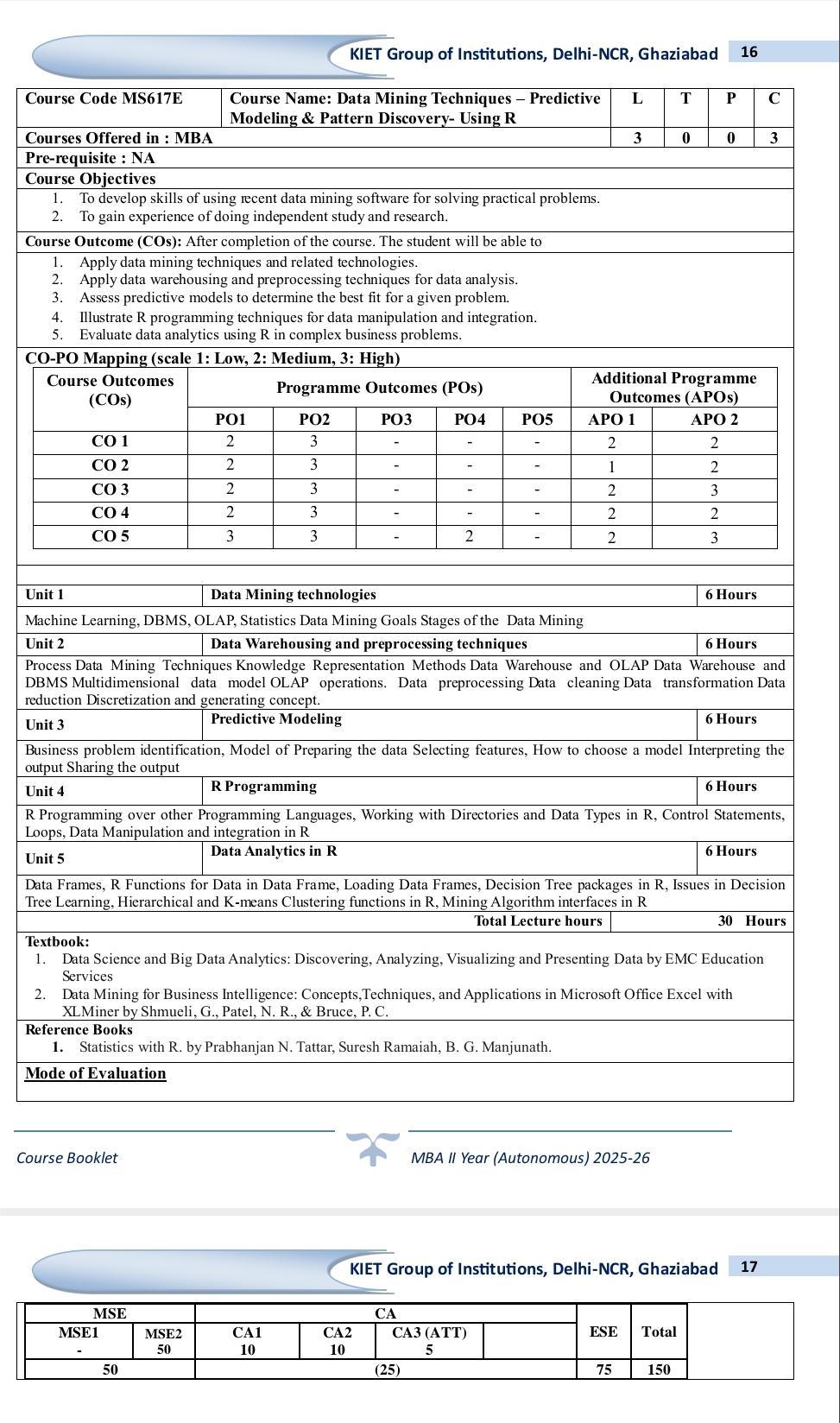
Evaluation is through MSE (50 marks), CA (25 marks), and ESE (75 marks), totaling 150 marks.