Search results: 329
The curriculum is designed to provide a comprehensive education in IoT and Embedded Systems with a focus on both theoretical knowledge and practical skills. It is structured to ensure that students gain a solid foundation in core subjects while also having the flexibility to explore interdisciplinary elements.
Core Area:
Sensing Devices and Transducers: Introduction to various sensors and transducers, their working principles, and applications.
Embedded Systems Fundamentals: Covers basics of Embedded C programming, interfacing techniques, and the architecture of microcontroller boards such as Arduino and Raspberry Pi.
IoT Board Programming: Hands-on experience with IoT boards Node MCU, programming, and interfacing with different sensors and actuators.
Smart Sensor Technologies: Advanced topics in smart sensors and their application in real-world monitoring systems.
The curriculum is designed to provide a comprehensive education in Robotic Systems & COBOTS with a focus on both theoretical knowledge and practical skills. It is structured to ensure that students gain a solid foundation in core subjects while also having the flexibility to explore interdisciplinary elements.
Core Area:
Basics of Robotics & COBOTS: Introduction to robotics and COBOTS, their working principles, and applications.
Embedded Systems Fundamentals: Covers basics of Embedded C programming, interfacing techniques, and the architecture of microcontroller boards such as Arduino/ESP32.
Arduino IDE Programming: Hands-on experience with TinkerCad and Arduino boards, programming, and interfacing with different sensors and actuators.
AI in Robotic Applications: Advanced topics in Role of AI in modern robotics and their application in real-world monitoring systems.
Data Analytics Lab Using R

- Teacher: DR SEEMA MAITREY [CSE]
- Teacher: Latika Sharma [CSIT]
- Teacher: Mr. Deep Kumar [CSIT]
Linear Algebra-I: Matrices and their properties, rank by echelon form, Rank, nullity, Eigen Values and Eigen Vectors, Inner Product and projections.
Linear Algebra-II: Similarity transformation, Diagonalization (2x2), EVD (Eigen Value Decomposition, SVD (Singular Value Decomposition), Matrix Factorization, LU- Doolittle Method.
Probability and Distributions: Probability and Conditional Probability, Bayes’ Theorem, Discrete and Continuous Distributions, Binomial Distribution, Poisson Distribution., Normal Distribution , Expectation and variance.
Descriptive Statistics and Interference: Mean, Median, Mode, Standard Deviation, Correlation, Sampling Techniques Sampling Theory (Small and Large), Hypothesis, Null hypothesis, Alternative hypothesis, Testing a Hypothesis, Level of significance, Confidence limits, t-test.
Calculus and Optimization Basics: Partial Derivatives, Composite Function, Total Derivatives, Chain Rule and Gradient Computation, Gradient Descent Algorithm, Learning rate and convergence.
- Teacher: Mr. Saurabh Choudhary [MCA]
- Teacher: Mr. Vijay Kumar [MCA]
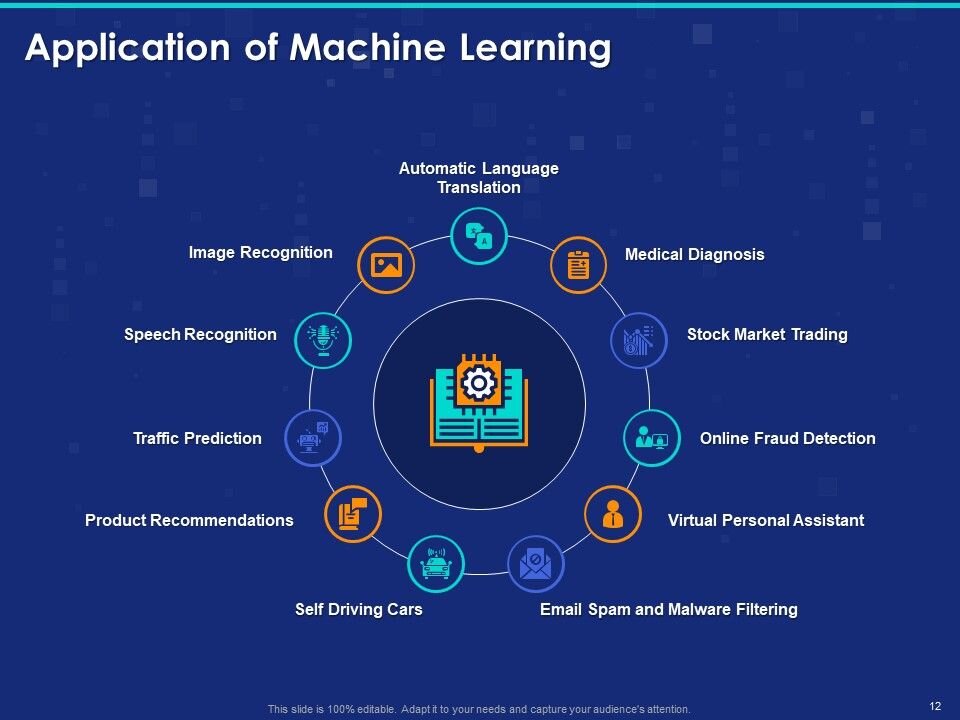
Machine learning (ML) is a type of artificial intelligence (AI) that allows software applications to become more accurate at predicting outcomes without being explicitly programmed to do so. Machine learning algorithms use historical data as input to predict new output values.
Recommendation engines are a common use case for machine learning. Other popular uses include fraud detection, spam filtering, malware threat detection, business process automation (BPA) and predictive maintenance.
Why is machine learning important?
Machine learning is important because it gives enterprises a view of trends in customer behavior and business operational patterns, as well as supports the development of new products. Many of today's leading companies, such as Facebook, Google and Uber, make machine learning a central part of their operations. Machine learning has become a significant competitive differentiator for many companies.
- Teacher: Rashika Bangroo [CSIT]
- Teacher: Sonia Deshmukh [CSIT]
- Teacher: Dr. Sudhir Kumar Sharma [CSIT]
- Teacher: Dr. Sudhir Kumar Sharma [CSIT]
- Teacher: Chandan Kumar [CSIT]
- Teacher: Ms. Jyoti [CSIT]
- Teacher: MR ANKUR BHARDWAJ [CSE]
- Teacher: Mr Gaurav Parashar [CSE]
- Teacher: MR HRIDAY KUMAR GUPTA [CSE]
- Teacher: Mr. UMANG RASTOGI [CSE]
- Teacher: Dr. Sushil Kumar [CSE]
- Teacher: Mr. Saurav Chandra [CSE]
- Teacher: MS HIMANSHI CHAUDHARY [CSE]
Mechanical Engineering Department
B. Tech, VIth Semester
Make-Up Examination, (2020-21) Even Semester
(NDT) (KME 061)
1. Attempt all the questions
2. The question paper consist of 50 Questions
3. The duration of question paper is 90 minutes
4. The correct question will have a weightage of +2 marks
5. wrong answer has the weightage of 0 mark
6. Unattempted question fetches zero marks
The objective of this course is to develop the ability to apply the concepts, tools and techniques
of economics in analysing and interpreting business decisions.