Search results: 232
- Teacher: MR CHIRAG ARORA [ECE]
Data Structure is a core subject of Computer Science. The study of data structure allows us to understand the organization of data and the management of the data flow in order to increase the efficiency of any process or program. Data Structure is a particular way of storing and organizing data in the memory of the computer so that these data can easily be retrieved and efficiently utilized in the future when required.
- Teacher: Dr. Saurabh Sharma [IT]
- Teacher: Mr. Sherish Johri [IT]
Data Structure is a core subject of Computer Science. The study of data structure allows us to understand the organization of data and the management of the data flow in order to increase the efficiency of any process or program. Data Structure is a particular way of storing and organizing data in the memory of the computer so that these data can easily be retrieved and efficiently utilized in the future when required.
The widespread popularity of digital cryptocurrencies has led to the foundation of Blockchain, which is fundamentally a public digital ledger to share information in a trustworthy and secure way. The concept and applications of Blockchain have now spread from cryptocurrencies to various other domains, including business process management, smart contracts, IoT, and so on.
At the end of the course, students will be able to "Comprehend the structure of Blockchain networks", "Evaluate security issues relating to Blockchain and cryptocurrency" Design and analyze the applications based on Blockchain technology".

|
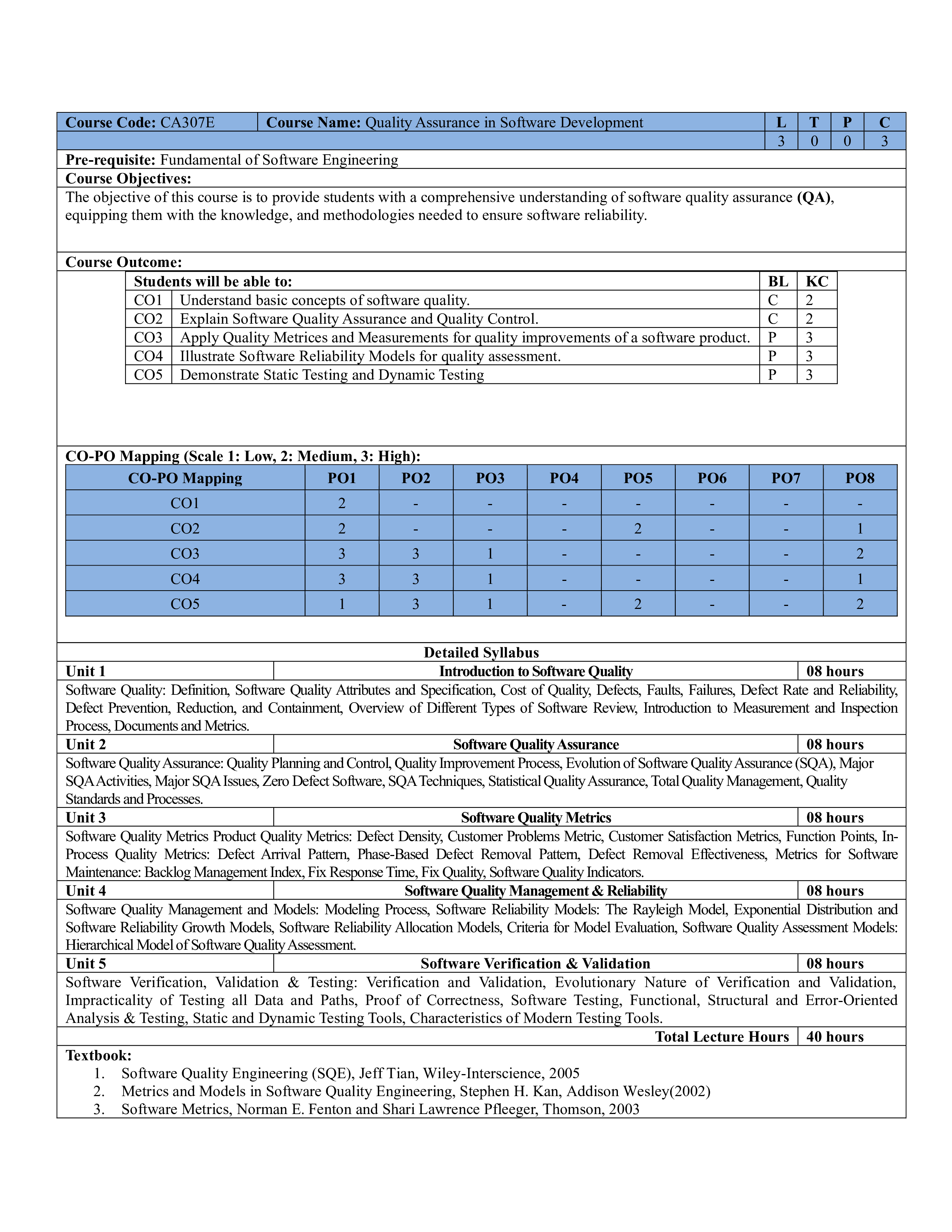
Detailed Syllabus |
|
|
Introduction to Software Quality |
|
|
Software Quality: Definition, Software Quality Attributes and Specification, Cost of Quality, Defects, Faults, Failures, Defect Rate and Reliability, Defect Prevention, Reduction, and Containment, Overview of Different Types of Software Review, Introduction to Measurement and Inspection Process, Documents and Metrics. |
|
|
Software Quality Assurance |
|
|
Software Quality Assurance: Quality Planning and Control, Quality Improvement Process, Evolution of Software Quality Assurance (SQA), Major SQA Activities, Major SQA Issues, Zero Defect Software, SQA Techniques, Statistical Quality Assurance, Total Quality Management, Quality Standards and Processes. |
|
|
Software Quality Metrics |
|
|
Software Quality Metrics Product Quality Metrics: Defect Density, Customer Problems Metric, Customer Satisfaction Metrics, Function Points, In-Process Quality Metrics: Defect Arrival Pattern, Phase-Based Defect Removal Pattern, Defect Removal Effectiveness, Metrics for Software Maintenance: Backlog Management Index, Fix Response Time, Fix Quality, Software Quality Indicators. |
|
|
Software Quality Management & Reliability |
|
|
Software Quality Management and Models: Modeling Process, Software Reliability Models: The Rayleigh Model, Exponential Distribution and Software Reliability Growth Models, Software Reliability Allocation Models, Criteria for Model Evaluation, Software Quality Assessment Models: Hierarchical Model of Software Quality Assessment. |
|
|
Software Verification & Validation |
|
|
Software Verification, Validation & Testing: Verification and Validation, Evolutionary Nature of Verification and Validation, Impracticality of Testing all Data and Paths, Proof of Correctness, Software Testing, Functional, Structural and Error-Oriented Analysis & Testing, Static and Dynamic Testing Tools, Characteristics of Modern Testing Tools. |
|
- Teacher: MR ANKIT VERMA [MCA]
- Teacher: Dr Rahat Ullah Khan [EN]
|
Course Objectives: |
|
· To acquaint the students with legacies of constitutional development in India and help those to understand the most diversified legal document of India and philosophy behind it. · To make students aware of the theoretical and functional aspects of the Indian Parliamentary System. · To channelize students’ thinking towards basic understanding of the legal concepts and its implications for engineers. · To learn procedure and effects of emergency, composition and activities of election commission and amendment procedure. |
A data structure is a storage that is used to store and organize data. It is a way of arranging data on a computer so that it can be accessed and updated efficiently.
It comprises of 5 units.
On moodle, you will get Notes, PPT, Assignments, Video links, Quizzes, previous papers, and other related material.

- Teacher: Dr. HARSH KHATTER [CO]
- Teacher: MR. ANURAG MISHRA [CS]
- Teacher: MR. PAWAN KUMAR PAL [CS]
- Teacher: MR. SREESH GAUR [CS]
- Teacher: Dr. Rishabh Jain
1. To Develop Critical Thinking Skills
2. To Enhance Awareness of Current Affairs
3. To Apply Theoretical Knowledge to Real-World Situations
4. To Improve Analytical and Interpretation Skills
5. To Strengthen Communication and Presentation Skills
6. To Encourage Multi-Dimensional Perspective
7. To Build Decision-Making and Problem-Solving Abilities
8. To Identify Business and Policy Implications
9. To Promote Independent Learning and Opinion Formation

To help students understand digital and social media marketing practices.
To provide understanding of the concept of social media platforms
To impart learning on various digital channels and how to acquire and engage consumers
online.
To provide insights on building organizational competency by way of digital marketing
practices and cost considerations.
To develop understanding of the latest digital practices for marketing and promotion.
- Teacher: MS. PALLAVI SHARMA [CS]
- Teacher: Mr. Rahul Kumar [IT]
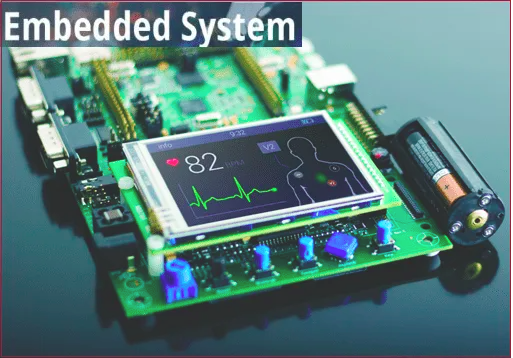
An embedded system is a microprocessor-based computer hardware system with software that is designed to perform a dedicated function, either as an independent system or as a part of a large system. At the core is an integrated circuit designed to carry out computation for real-time operations.
Complexities range from a single microcontroller to a suite of processors with connected peripherals and networks; from no user interface to complex graphical user interfaces. The complexity of an embedded system varies significantly depending on the task for which it is designed.
Embedded system applications range from digital watches and microwaves to hybrid vehicles and avionics. As much as 98 percent of all microprocessors manufactured are used in embedded systems.
UNIT-1: Energy Scenario: Classification of Energy, Indian energy scenario, Sectorial energy
consumption (domestic, industrial and other sectors), energy needs of growing economy, energy
intensity, long term energy scenario, energy pricing, energy security, energy conservation and its
importance, energy strategy for the future.
Energy Conservation Act 2001 and related policies: Energy conservation Act 2001 and its
features, notifications under the Act, Schemes of Bureau of Energy Efficiency (BEE) including
Designated consumers, State Designated Agencies, Electricity Act 2003, Integrated energy policy,
National action plan on climate change, ECBC code for Building Construction.
UNIT-2: Demand Side Management (DSM): Concept and Scope of Demand Side Management,
Difference between Energy Efficiency and DSM, Evolution of Demand Side Management, DSM
Strategy, Planning, Implementation and its application, Customer Acceptance & its implementation
issues, National and International Experiences with DSM, UDAY scheme and other government
initiatives for DISCOMs.
Energy Monitoring and Targeting: Defining monitoring & targeting, elements of monitoring &
targeting, data and information-analysis, techniques –energy consumption, production, cumulative
sum of differences (CUSUM). Energy Management Information Systems (EMIS)
UNIT-3: Energy Audit: Aim of energy Audit, Strategies of Energy Audit, Energy management
Team Consideration in implementing energy conservation Programme, Process flow diagram, Energy
Audit report format, Benchmarking and Energy Performance, Instruments for energy audit, Economic
analysis.
UNIT-4: System Audit of Mechanical Utilities: Pumps, types and application, unit’s assessment,
improvement option, parallel and series operating pump performance. Energy Saving in Pumps &
Pumping Systems. Bloomers (Blowers) types & application, its performance assessment, series &
parallel operation applications & advantages. Energy Saving in Blowers Compressors, types &
applications, specific power consumption, compressed air system & economic of system changes.
Energy Saving in Compressors & Compressed Air Systems Cooling towers, its types and
performance assessment & limitations, water loss in cooling tower. Case studies related to Energy
Audit & Management in Industries
UNIT-5: Energy Efficient Technology: Need for Energy Efficient Devices, Life Cycle Assessment,
Comparison between simple pay-back and life cycle cost assessment, Energy Efficient Motors-motor
losses and loss reduction techniques, determining and comparing motor efficiencies, motor efficiency
testing standards, BIS specification for Energy Efficient Motors, efficiency as a function of load,
Energy Efficient Lighting Sources-compact fluorescent lamp, light emitting diode, LED lamp, role of
voltage on the efficiency of lighting system, Importance of Automatic power factor controllers,
Variable Frequency Drives.